
Science-Based Tricks for Habit Change


Brain-healthy lifestyles require us to break out of unhelpful routines and build better habits. We pretty much know what we’re supposed to do to take care of ourselves, right? Exercise, eat healthy, get enough sleep, etc. But we struggle to follow through. It turns out that each “falling off the wagon” moment (when we’ve failed once again to do what we promised ourselves we’d do) represents an underrated opportunity.
When these moments happen, we tend to focus on our feelings of disappointment, and even guilt or shame, for failing to fulfill our own expectations. But I’d like you to see that these are actually underrated opportunities for growth. Because it’s in these exact moments that we build our “failproof resilience” muscles, right?
Failproof resilience isn’t about avoiding failure. It’s about embracing it. Because this is how we build resilience—by bouncing back after failing to accomplish a goal.
Research in behavioral change has validated a number of concrete tools that can be helpful in supporting the ability to pick yourself back up, time and again. Tools like the WOOP Method and Experiential Learning make use of neuroscientific approaches to facilitate motivation and learning.
What’s WOOP?
The WOOP model is a scientifically validated technique developed by researchers studying how to tackle habit change. The practice has been shown to be easy to learn and effective in addressing specific health habits like food choices, weight management, and physical exercise. With just a bit of practice, WOOP skills help us to create a self-directed, customized plan of action, for the cost of a pencil and paper and 10 minutes of our time (see Fig 1).

We begin by developing a clear vision for our Wish, delving into how that desire connects to our values and identity. The fastest way to go deeper in finding that meaningful source of motivation is by asking yourself “Why?” repeatedly. Ask, “Why?” at least 4-5 times. For example, we may have a sense that we should be going to bed earlier because it’s better sleep hygiene. Asking another, “Why?” can take us deeper, tying into our desire to be more productive at work. The next layer of Whys may be about wanting better brain health.
Aligning motivation with what matters most creates a “pull” energy
And going yet deeper takes us to our Compelling Whys. Those that touch the heart, like wishing to stay active and engaged in our kids’ and grandkids’ lives as we grow older. Accessing our motivation as it aligns with what matters most to us creates a kind of “pull” energy that helps to bolster our willpower so we can stay in integrity in that important moment of choice.

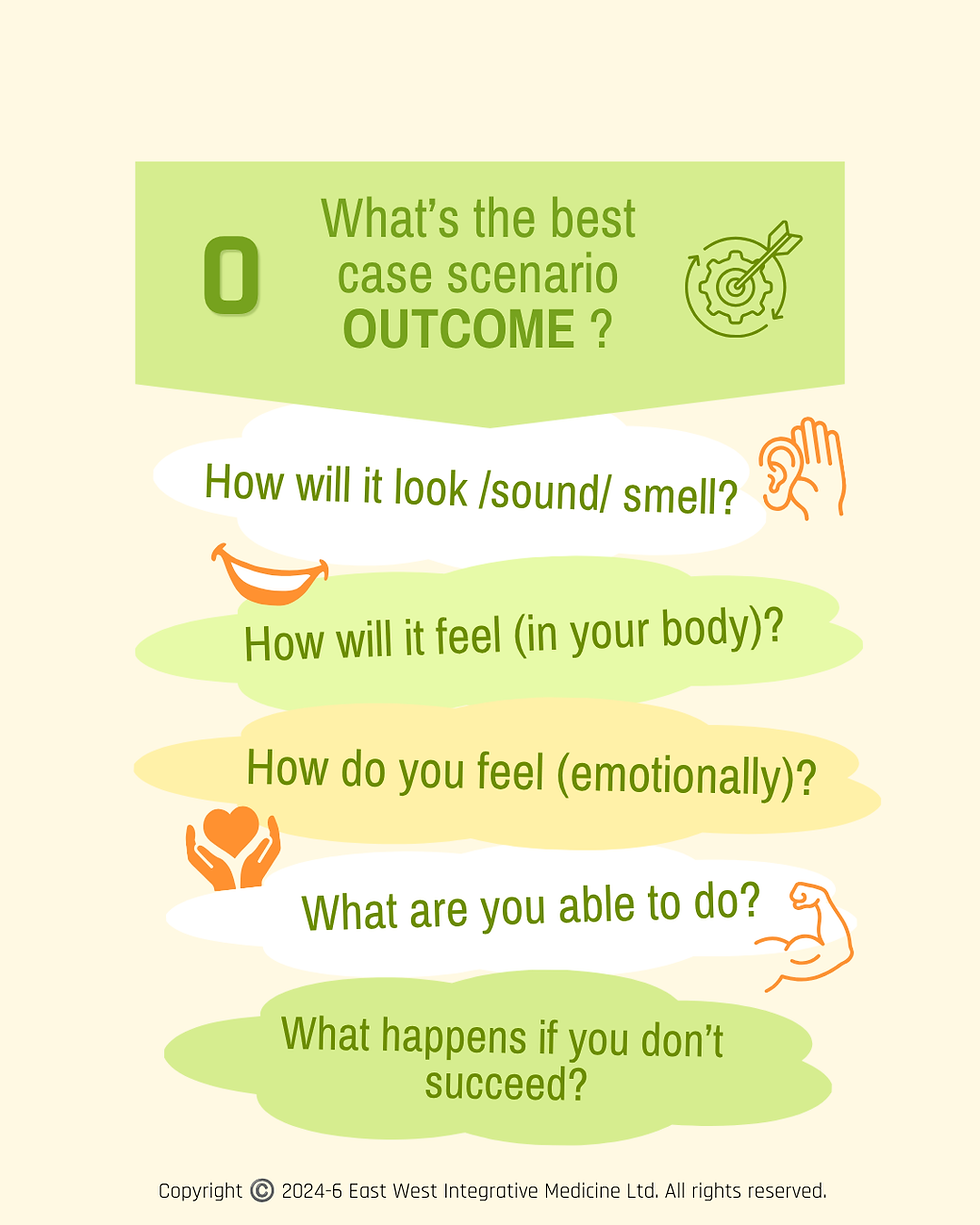
The next step is to envision the best case scenario Outcome for yourself, in as much detail as possible. You want to begin with the end in mind. This means creating the outcome that you want in your mind first.
Clarity comes with spending time imagining what success looks like, what it will sound like, what smells or other sensory input can you envision? Athletes routinely use mental imagery to prime their brains for success, rehearsing their winning moves in as much detail as possible—like playing a 4D movie reel over and over again.
When you are envisioning your ideal outcomes, expect your mind to automatically come up with objections and worse-case scenario trajectories. This is to be expected, since our minds are automatically programmed to protect us against threats. Changes are perceived as threatening, and many of us are used to thinking of failure as shameful and to be avoided at all costs.
Don’t let this stop you. These objections and worse-case scenario projections are all part of the process, allowing us to figure out how to tackle them by anticipating and making decisions ahead of time.
Research has shown that mental contrasting can be highly effective in activating mechanisms that enable expectations for success at cognitive, emotional, and visceral levels. This sometimes happens consciously and sometimes unconsciously, providing support to the part of the mind that is forming bonds with our desired future reality. These bonds create more “pull” energy, keeping us motivated and moving us forward.

The Obstacles component of WOOP gets us to write out every single objection our mind throws up. We get the opportunity to notice that many of these may or may not be real obstacles, but can feel emotional nonetheless. The mind will naturally look for all kinds of reasons to stay stuck in the status quo or comfort zone of existing habits. So the trick is to get them all out so we can see them, and begin brainstorming our Plans for how to approach these obstacles should they arise.
These Plans represent the roadmap that will keep us on track with habit change. For example, we may be thinking that we have “too much to do,” and that’s what’s been getting in the way of our going to sleep on time. Rather than choosing to buy into that idea, we can reflect on times in our lives when we’ve really felt overwhelmed, and consider if everything that we “have” to do really carries the same importance. Would it be possible to prioritize and plan, or even park some other “To Dos” in the “Perhaps” category for the future? There is no need to overthink any of this. Keep it simple. Set yourself a timer and remind yourself that there is no right or wrong here.
Playing in the Sandbox
The Experiential Learning cycle works with how the brain encodes habits at the basic biological level. Because the brain is wired to predict what happens next, it is constantly building cycles of prediction, action, feedback, and adjustment. Our deepest and most enduring learning happens through actively trying, reflecting, and trying again. That’s why we can’t learn to ride a bike by reading about it or even by watching someone else ride. We have to physically get on that bike, wobble, fall down, get up, and try again, before we can actually learn how to ride it.
The brain learns more when something doesn’t work, than when it does
N-of-1 trials are a way of trying out different ideas, when we are trying to change a habit. We get to be both the scientist and the guinea pig. It’s like playing in the sandbox of discovery, a low-stakes approach to tweaking and trying out new ideas.
When we approach habit change like this—as an experiment, rather than a test of discipline—our brains are naturally rewarded by learning and novelty. So our dopamine pathways are stimulated, creating neural circuits that pull us forward with curiosity and the desire to explore. No more need to rely on willpower alone.
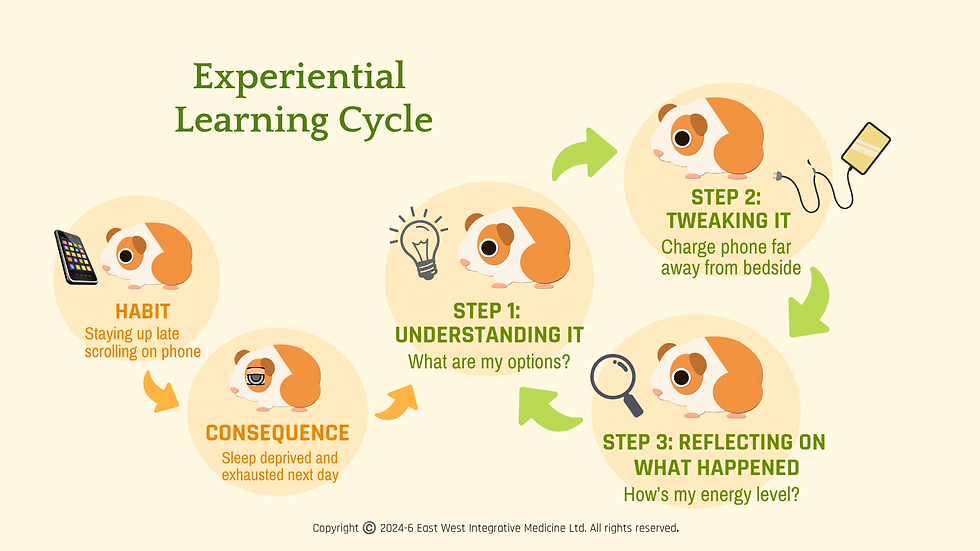
For example, imagine you’re a guinea pig we’ll call Gracie. Gracie noticed that she was always waking up feeling groggy and exhausted (Fig 5). She realized that she’d inadvertently gotten into the habit of staying up late scrolling on her phone, and she just couldn’t seem to break the habit.
The first step for Gracie was to understand what was happening so she could figure out her options for how to change things up. The next step involved tweaking. She decided to try charging her phone away from her bedside. The third step was to reflect on what happened, paying particular attention to her energy levels the day after her experiment. Gracie could then decide if she wanted to keep trying that approach, or what further tweaks might be helpful to her.

This kind of experiential learning pulls us forward because our brain creates an open-loop cycle as it predicts what will happen next. When things don’t work out as they’re supposed to, the brain creates a learning signal in response to its “prediction error.” The brain updates and consolidates its learning based on this error, which is how we make meaning from experiences. Reflection then shines a light on our habit loop, down in the unconscious realm of the subcortical brain, allowing the prefrontal cortex (PFC) to create new hypotheses and predictions based on what it has learned.
Treat obstacles as speedbumps rather than roadblocks
Notice that the brain learns more when something does not work, than when it does. Prediction errors require our brain to gather more data, refine the approach, and try again. This builds momentum for a self-perpetuating process that builds better habits, while also expanding our problem-solving capacity. Active experimentation naturally requires repetition. And as we begin to feel better and see improvement, our brain is rewarded and gradually rewired through this process of discovery.
Can Do vs. Can’t Do
Let’s come back to the concept of “falling off the wagon” being the most underrated opportunity in the habit change process. Each time we fail to meet our goals, we have the option of either giving up or deciding to try again. Our main problem with habit change is expectation. We expect it to be simple and quick. We underestimate the depth and complexity of existing habits. And what’s worse, most of us have come to believe that we aren’t good at habit change. We’ve become so familiar with the disappointment of failure, feel discouraged, and quit trying. We’re in the habit of telling ourselves that it’s not worth the effort. I call this the “Can’t Do” habit loop.
It takes time and patience to uproot old habits and implement new ones. So what if we anticipate failure, or even welcome it, as the best way to learn more about ourselves each time? We could anticipate that we will feel disappointment when things don’t go as planned in our experiments. What if it were possible to ride out our feelings like disappointment and frustration? We could acknowledge those feelings without becoming overwhelmed by them. Allow them to be tempered by curiosity. As we figure out what to try next, our curiosity and the novelty of trying new ideas keeps our momentum rolling in the “Can Do” habit loop.

Grit is about maintaining effort over years, despite failures and challenges. Motivation is strengthened by clarifying how our Compelling Whys align with our values and self-identity, pulling with forward momentum. And when our progress is slowed by unexpected obstacles—whether caused by our own inadequacies or by external challenges—the trick is to treat them as speedbumps rather than roadblocks.
Sustaining momentum is about building the habit of figuring out how to bounce back, treating each failure as an opportunity to learn rather than a painful endpoint.
Dr Em coaching tips
WOOP - Remember not to overthink the exercise. Set your timer for 20 minutes.
What lifestyle habit have you been thinking about that would have the highest yield for your brain health right now?
If you aren’t sure, figure it out by taking 5 minutes to do the Brain Health Quiz HERE.
WISH - Write down what you want to change, and why. Keep asking yourself, “Why?” and writing down the answers at least five times, until you get to the Compelling Why that touches your heart.
OUTCOME - Envision your best case scenario outcome. Visualize and embody it in all your senses, in your body, with your emotions.
Write down all the OBSTACLES that your mind comes up with during this exercise, and any others that you can think of.
Then, brainstorm your PLAN for overcoming these obstacles.
Experiential Learning - Considering the habit that you have chosen above, What’s the best approach to changing this habit?
If it doesn’t feel easy and simple enough to do right now, make it smaller and less drastic of a change. (Small is mighty!)
If it still doesn’t feel ridiculously easy, make it even smaller. (Remember it has to be small enough for a guinea pig.)
Decide how you will measure whether your experiment worked or not. More focus? More energy?
Decide ahead of time how you will feel when your experiments fail. Disappointment? Frustration? Sadness?
What have you learned from #1 that gets you excited to keep rolling on the next experiment?
Looks like you’re ready to GO FOR IT!


Comments