
The Neuroscience of Habits


It’s pretty exciting to learn that up to 45% of dementia cases might be preventable just through lifestyle choices. It’s the choices we make every day: how we exercise, what we eat, and even when we sleep! It all plays a role in our cognitive function.
And beyond physical health habits, our daily habits of social connection, intellectual challenge, and doing meaningful work, also boost our brain health. On the other hand, chronic stress and ignoring hearing or vision issues can quietly undermine brain resilience over time.
Many of us are already doing our best to follow brain-healthy lifestyle choices, but there’s always room for improvement. And the reality is that we tend to struggle a bit when it comes to following through with our best intentions.
Habits are tied to brain health
I like to envision a brain-healthy lifestyle as being like the house that serves to protect our brain health. That house is built from the individual bricks of our health habits (see Fig. 1). The good news is that we already know what to do. We mostly all learned the basics of what’s good for us by kindergarten (think: brushing our teeth, exercising, eating healthy, and getting to bed on time).
Chances are that there are times when you feel like you’re on your game and your health habits are all dialed in. But then, when life throws you a curve ball, your routine goes out the window and it becomes harder to get back on track. We have a tendency to fall into old habits at these times, because they represent a kind of easy and familiar comfort zone for the brain.
Easy, because our routine behaviors represent neural shortcuts that save time and energy. Familiar, because repeated signalling along the same neural pathways causes them to become wired together, forming automation loops. Automation shifts the control from the prefrontal cortex (PFC) (where decisions are made) to the basal ganglia (which specialize in pattern recognition and procedural memory) and to the nucleus accumbens (where habit loops are reinforced by dopamine).

The brain prefers to create automation whenever possible. This saves energy and reduces stress. Autopilot settings improve efficiency and avoid uncertainty. That’s how brushing our teeth feels effortless. It allows our prefrontal cortex (PFC) to focus on higher order tasks (like problem solving). And whatever we keep doing on repeat becomes a habit, like it or not.
Even when we think we’re actively making decisions on a day-to-day basis, research shows that 45-65% of our daily actions are driven by habit.
So automation can work in favor of brain health for certain habits (brushing our teeth), but it works against us when it comes to unwanted habits (like, when we find ourselves automatically reaching for snacks while watching TV, inadvertently reinforcing default habit loops through repetition). Such habits feel good in the short-term but become difficult to change over time, because they represent a kind of comfort zone.
Habits are basically shortcuts for the brain
We tend to judge ourselves harshly when it comes to certain habits, but it’s important to recognize that many industries profit from intentionally exploiting the vulnerability of our human brain.
For example, ultra-processed foods are constantly being chemically optimized to a ‘bliss point’ that maximizes pleasure. This results in an immediate dopamine hit after ingestion. The brain’s reward center goes into hyperdrive with this kind of artificial stimulation, which in turn, amps up cravings and urges to keep us hooked.

Our challenge is to learn to enable the brain to automate helpful habits so that they become routine and frictionless, while also finding ways to unhook from unhelpful habits.
We each need to assess how satisfied we are with key elements of our lives (like sleep, movement, nutrition, and stress resilience). Bringing curiosity, rather than judgment, to this work allows us to decide which habits we want to keep and what needs to change.
Even just becoming aware that lifestyle choices can have the potential to impact brain health builds new neural pathways! This is neuroplasticity in action! The brain adapts and rewires according to what you pay attention to. So taking a deep dive into habit change is like checking under the hood to see how habits work. The habit of inquiry and insight isn’t just about acquiring new knowledge. It’s one of the most powerful habits we can build for ourselves.
Will power and won’t power
One of the main reasons we struggle with habit change is because we believe that we need to rely on sheer willpower. In scientific terms, willpower is essentially self-regulation (or the ability to resist immediate gratification in pursuit of longer term objectives). Popular societal narratives place tremendous value on self-control and discipline as being virtuous. We believe that success depends on grit and discipline, and that failure is due to weakness. This model is appealing in its simplicity, but willpower is only part of the equation, failing to account for the intricacies of how the brain actually works.
Willpower lives in the prefrontal cortex (PFC) (where we consciously control impulses, make decisions, plan, and execute). So it makes sense that we would think of the PFC as being the command center of the brain. Willpower depends in part on genetics and early development and can also be strengthened with practice. When we are on top of our game, willpower helps us focus on our goals and resist urges. We are able to overcome impulsive behaviors by using top-down control to prioritize and stay focused on the future outcome we want.
Willpower is only part of the equation when it comes to habit change
The problem is that willpower is like a muscle, meaning that it’s prone to fatigue. You may have noticed that willpower tends to be stronger in the morning when we are well-rested and stress levels are low.
Over the course of the day as the PFC is tasked with more decisions, it gets stressed, overloaded, and eventually exhausted. That’s why it’s usually easier to skip the doughnut in the morning, but harder to ignore the siren call of cookies by mid-afternoon.
Habit loops live in the subcortical regions of the brain, supporting automation, emotion, and reward. Cravings and urges come from bottom-up control mechanisms that often operate far more quickly than conscious thought, which is why we can sometimes find ourselves reflexively eating the cookie despite our best intentions.
The relationship between the PFC and limbic system has been likened to a rider on an elephant. The rider likes to think that they’re in charge, but in reality, the elephant is faster, more powerful, and can act beyond the bounds of conscious or rational thought. While willpower can help to bring about habit change, it’s neither powerful nor consistent enough to overcome the “won’t-power” of entrenched habits.

We tend to discount the power of habits, because they happen on autopilot, but there’s a lot going on under the surface. We see habits as being about visible actions like eating a cookie. But every action is linked to invisible habits of thinking and feeling that run underneath our conscious awareness, creating a kind of inertia or “won’t-power” that resists change.
The good news: Won’t-power inertia becomes accessible to us when we learn to shine a light on the thoughts and feelings that are perpetuating the comfort zone of existing habits.
Beliefs are habitual thoughts that seem true because they’ve been repeated so often in our heads. Sometimes they are inherited from family or internalized from social norms like, “It’s rude to refuse these cookies that my co-worker Beth offered me!” At other times they serve as rationalizations like, “I missed lunch, so I need this cookie to give me energy.” Habitual emotions like guilt may be tied to rationalizing thought habits, as in, “I’ll feel bad if Beth is disappointed.” Or they can kick in after eating the cookies as a kind of nauseating aftertaste like, “Ugh, I definitely should not have eaten those cookies.”

Befriending the elephant
Once we see that it’s possible to hack into the limbic system, we’re no longer relying on willpower alone. We learn that it’s possible to befriend the elephant and to develop a dialogue with the creature part of ourselves. Breaking free of existing thinking patterns requires us to unpack and examine our beliefs. It requires us to ask if there are other ways to think about a situation. Mindset dexterity skills help us to question whether it really is rude to refuse Beth’s cookies or if there are polite ways to say no.
Feeling habits are often tethered to thinking habits. In this case, we need to acknowledge that feeling guilty for disappointing Beth could be an obstacle to our goal of avoiding sugary snacks. The reality is that we are disappointing ourselves when we eat Beth’s cookies just to please her. And that’s how the comfort zone becomes uncomfortable over time. It still feels easy and familiar, but also crowded with habitual feelings of guilt and shame when we’re always prioritizing other people’s needs over our own. Feelings fluency skills can help us stay grounded in the midst of transient uncomfortable physical sensations that are associated with certain emotions.
Knowing that habits of thought, feelings, or behaviors can be modified or even discarded, is tremendously empowering. Rather than staying stuck in the comfort zone beginning to feel too crowded or even frustrating, we realize that there are savvy strategies beyond willpower for approaching habit change.
Our motivation is driven by clarifying how our compelling whys align with our values and self-identity. This is what initiates forward momentum for habit change. But progress can be slowed by unexpected obstacles, whether caused by our own inadequacies or by external challenges.
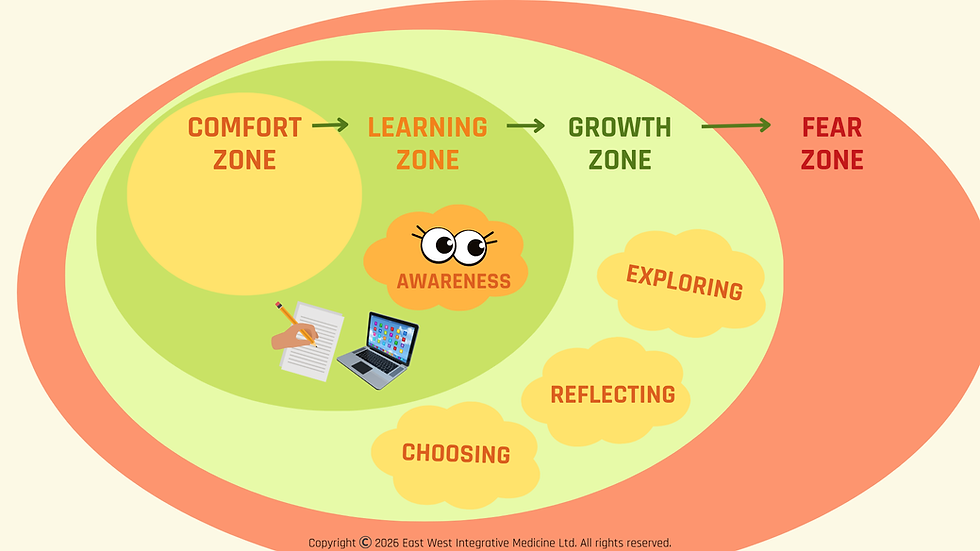
It turns out that the most underrated aspect of habit change is how much “falling off the wagon” helps to build more grit. It takes courage, humility, and strength to bounce back after failing. Sustaining momentum is about treating each failure as an opportunity to learn rather than a painful endpoint. We learn to treat obstacles as speedbumps rather than roadblocks, allowing curiosity to serve as a force that gently pulls us out of the comfort zone and into the learning and growing zones (See Fig 4).
The comfort zone gets uncomfortable when other people’s needs always come first
Grit is about maintaining effort over years, despite speedbumps. But it shouldn’t have to be all blood, sweat, and tears. I prefer to envision habit change as playing in the sandbox of discovery about myself, conducting n-of-1 trials. N-of-1 studies are a scientifically validated experimental design where a single study subject serves as the test subject and control. In this case I get to be both the scientist and the guinea pig! It’s a low-stress way of tweaking and trying out new ideas.
Approaching habit change as an experiment rather than a test of discipline, allows our brains to be naturally rewarded by learning, novelty, and mastery. Tweaking and trying out new theories becomes its own habit loop, creating new neural circuits that pull us forward with motivation, rather than relying on willpower alone.
Dr Em coaching tips
Write down the four foundational elements for brain health: Eat, Move, Sleep, Stress ResilienceOn a scale of 0 to 10, score the impact of trying to shift your habits in each. Then, score the level of difficulty you’d anticipate in terms of taking on the challenge in each.
Take the element above with the highest impact and the lowest level of difficulty. See if you can come up with three “n-of-1” experiments for yourself that represents a 2% tiny step in the direction of actually doing it. Choose which one would be easiest to start today. Then, start today!


Been looking for a crossword generator that doesn't watermark the PDF. This one just works — AI clues saved me an hour of brainstorming.